Christian College Economic Degree
By clicking on the "Continue" and/or "Submit Request" button(s) on this form I am providing my electronic/ESIGN signature and agreement of expressed written consent to permit The Christian Connector, Inc. and the schools selected, and the parties calling/texting on behalf of the schools, to contact me at the phone number I provide for marketing purposes, including through the use of automated technology, SMS/MMS messages, and prerecorded/artificial/AI generated voice calls about education related opportunities. Message and data rates may apply. I understand that my consent is not required to obtain any goods or services from The Christian Connector or any of the colleges/universities. I acknowledge that I may select as many, or as few, schools as I wish to receive information from. I agree to the terms and privacy policy as well. I understand I can call 800-667-0600 to request information without providing any phone number.
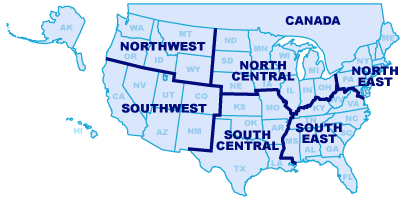
Click on the map below to bring schools in the selected region to the top of the list:







Articles on Economics:
A Future with an Economics Degree
By Calli Wolfenden, Staff Writer
Economics is the study of scarce resources and how societies and people groups allocate and use them to meet needs. That is the broad-spectrum definition. Some other aspects that go into that, inevitably, are business, money, markets, inflation, and (to a degree) politics. Because how we use our scarce resources is seen in so many different areas of life and involves so many different decisions, made at different levels, economics tends to touch a lot of other areas of study, making it almost a renaissance-man degree.
Getting an economics degree from a Christian college allows students to learn about the scarcity of all our natural resources from the perspective of knowing the God who made them and answering his call to steward His creation. The degree comes with the understanding that we are called to not only use but care for His creation, including people. An economics degree from a Christian college will not only call to attention our responsibility to steward God’s creation, but to do so ethically, with respect to others and to the Lord.
Some example careers for those who major in economics:
- Economist: An economist studies how resources are allocated by individuals, governments, or businesses to meet needs or wants. They analyze data and may be able to predict economic outcomes from their research, which can be used to advise on strategies, policies, or solve problems having to do with limited resources or poverty.
- Securities and Commodities Broker: A Securities and Commodities Broker handles the investments and the buying and selling of financial instruments (like bonds, stocks, and commodities) for a client. They have deep knowledge of financial markets and regulatory compliance, and are able to build investment portfolios for clients, trade on their behalf, and advise them in ways to help them reach their financial goals.
- Financial analyst: A Financial Analyst advises individuals or businesses on investment opportunities, financial decisions, or strategies to help them find the best return on investment or risk mitigation options. They do this through analyzing financial statements, assessing the viability of investment opportunities, and forecasting performance based on market trends.
- Urban planner: Urban Planners work with the government, developers, and communities to create plans and develop policies to encourage the growth and development of towns, cities, and regions. They create designs that are sustainable and efficient through analysis of land use, population trends, environmental impacts, and transportation.
- Statistician: Statisticians collect data and analyze it to solve problems and provide data-driven support for decisions. They gather data using surveys, designed experiments, or studies, and through statistical methods, mathematical techniques, and software tools, they draw conclusions or create predictive models to forecast outcomes.
- Sports Economist: Sports Economists study the economic aspects of sports and the sports industry to understand and optimize their sustainability and economic performance. They analyze and examine things like player salary, team finances, the relationship between market forces and ticket prices, sponsorships, broadcasting rights, and the economic impact of sporting events. Their analysis and data can help inform teams, leagues, and government agencies on decision-making and building good economic strategies.
- Actuary: Actuaries play big roles in helping clients, agencies, or governments make sound financial decisions by assessing the risk to a decision using mathematics, economic theories, and statistics. They evaluate the potential cost of risks and the likelihood of events occurring through analyzing data, which is then used to come up with policies and strategies to mitigate potential financial losses. They often work in insurance or investment sectors.
There are no general placement rates for graduates with an economics degree, but the degree does hold a lot of promise with the average salary starting between $51,000 and $54,000 out of school and rising to over $70,000 in the first five years. This can make the field competitive, meaning that getting a leg up on the competition while still in school can make all the difference for your future career. To do that, there are some key things to focus on.
Strong academic understanding is essential, yes, but knowing how it applies is critical. You’ll take courses in macroeconomics, microeconomics, econometrics, and statistics, which will give you a base knowledge of the field. But you’ll want to keep up with current affairs and dedicate time weekly, or even daily, to reading up on current economic trends, stocks, and business news. These are what make up modern economics, so understanding how your course content is applied in real life is the purpose of your learning. Being able to see the relationship between your education and your future career will help you not only learn quicker, but also engage you in the career field giving you valuable insight into how things work.
Gaining practical experience is also key. Prioritize internships or part-time/summer jobs during your college career. These will help you gain not only viable career experience to help your resume stand out, but it will also help you build connections within the field. Building a network of contacts within the field, especially from those you’ve worked with, gives you references for future jobs or provides you with possible opportunities in the future. Additionally, internships or relevant part-time jobs are a great way to test the waters and see how you fit into the career field, whether you like it or not, before you’ve fully committed to economics.
Choosing to major in economics also means becoming technologically proficient. Modern economists work with computers and programs regularly. To help kickstart your career, become familiar with programs like excel, Stata, Python, and more early on. An economics degree involves a lot of work with numbers and math, as well as analysis. Strong aptitude for numbers and analytical thinking will make someone well suited to this degree. Creativity and adaptability are also great characteristics to have for economists, as recognizing problems does little without the ability to come up with creative and effective solutions. With these traits, someone will be a great fit for a career in economics in the business world, government, or even in ministry.
Works Cited:
- “How Much Money Can You Make with an Economics Degree?” CareerExplorer, www.careerexplorer.com/degrees/economics-degree/salary/. Accessed 25 Nov. 2024.
An Economics Degree and Ministry
By Calli Wolfenden, Staff Writer
All creation belongs to the Lord, which means that all resources come from Him. Someone with an economics degree will understand the ownership of the resources and the call from the Lord to responsibly steward what He has given us.
Genesis 2:15
“The Lord God took the man and put him in the Garden of Eden to work it and take care of it.”
Deuteronomy 26:12
“When you have finished setting aside a tenth of all your produce in the third year, the year of the tithe, you shall give it to the Levite, the foreigner, the fatherless and the widow, so that they may eat in your towns and be satisfied.”
Economics has a lot to do with money, but also with resources. Someone with an economics degree can be a great asset to ministries or the church through financial management, planning, or resources allocation. All resources are limited, there is nothing infinite except God. So, someone with an economics degree can help find the best way to use the resources available to the Church or ministry for the greatest impact or efficiency. These resources could be funds, people, land, or time.
They can also help with planning for missions’ work or ministry/missionary organizations in setting up small businesses, products, outreach, or preparing for the economic climate of a different country or region. They can help advise how to handle a foreign economy and prepare properly for it and come up with ways that they can sustain or support themselves through it. They can also serve their local community or church members by teaching financial stability and planning, and stewardship of resources.
There is no shortage of need for someone with an economics degree and the skills that are required for it. If you have a strong aptitude for numbers, are an analytical and creative thinker, technologically proficient, and are passionate about stewarding God-given resources, then perhaps the Lord is calling you to use your gifts through an economics degree.