Christian Journalism Colleges
By clicking on the "Continue" and/or "Submit Request" button(s) on this form I am providing my electronic/ESIGN signature and agreement of expressed written consent to permit The Christian Connector, Inc. and the schools selected, and the parties calling/texting on behalf of the schools, to contact me at the phone number I provide for marketing purposes, including through the use of automated technology, SMS/MMS messages, and prerecorded/artificial/AI generated voice calls about education related opportunities. Message and data rates may apply. I understand that my consent is not required to obtain any goods or services from The Christian Connector or any of the colleges/universities. I acknowledge that I may select as many, or as few, schools as I wish to receive information from. I agree to the terms and privacy policy as well. I understand I can call 800-667-0600 to request information without providing any phone number.
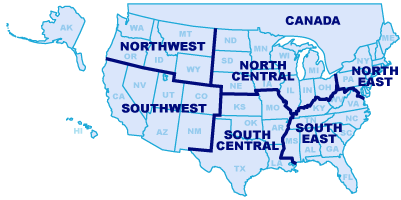
Click on the map below to bring schools in the selected region to the top of the list:







Articles on Journalism:
A Future with a Journalism Degree
By Calli Wolfenden, Staff Writer
Humans have a natural inclination for storytelling; journalism deals with the stories that are true and, usually, current. When we think of journalists, we think of newspapers, the annoying reporter chasing an interview, and the “Breaking News” headline with urgent music in the background. Those things are part of journalism, but at its core, journalism is telling a true story, informing people on what’s going on with accuracy, and upholding integrity, both in the telling of the story and those involved.
A Christian college offers students a study in journalism, truth, and the practice of integrity. Truth and integrity are integral characteristics for all Christians, as we see them modeled in the Bible, shown through the 10 commandments, and in countless examples throughout the Old and New Testament on how we should interact with each other and the Lord. Going to a Christian college for a journalism degree provides you with an environment that pursues truth, integrity, and the Lord and allows you to nurture your Spiritual life while growing toward your professional one.
Career options for someone who chooses to major in journalism:
- Journalist/Reporter: A Journalist/Reporter main job is to inform the public about current events or trends as accurately as possible. They do this by conducting interviews, research, and investigations and compiling the accounts and presenting them as objectively as possible. They must adhere to ethical standards and verify their sources of information. Their work may be presented in a variety of mediums, such as newspapers, radio, or television, among others.
- News Analyst: News Analysts go deeper into the context and significance of current events, providing insight, background, and commentary to help the audience/readers better grasp the issues discussed. They may offer predictions on potential outcomes on situations based on their research, they evaluate sources and examine trends to build the “bigger picture.”
- Editor: An Editor reviews, edits, and polishes content before publication to ensure that the work meets a certain standard, style, or vision. Editors check for things like grammar, spelling, creative choices, tone, and may even fact-check and verify sources and information, depending on the kind of content.
- Broadcast Producer: The Broadcast Producer is in charge of the content that goes into a type of broadcast, be it television, radio, or online programming. They work with writers, directors, content creators, talent, and crew throughout the production process, and have the final say in what is included and excluded from the final airing. In the long list of their responsibilities, scheduling, budgeting, and ensuring quality standards are among their primary roles.
- Graphic Design: Graphic designers are artists who work with technology to create virtual pieces related to branding, websites, advertisements, or many other electronic visuals that inform, educate, or bring users to the desired platform. They work closely with marketing departments or clients to execute their vision and create designs that are both aesthetically pleasing and on-brand. Graphic designers have a strong grasp of both artistic design and technology.
- Public Relations Specialist: A Public Relations Specialist is in charge of maintaining or improving the company’s reputation. They work to create a positive public image through communicating achievements, good works, community engagement, or other good things with the press, social media, or other public outlets. They also handle crisis management for negative events or bad publicity, working to minimize the damage to the company/client’s image.
Many universities post relatively high placement rates for graduates with a journalism degree, but not necessarily because they are turning out a lot of journalists. While most students who choose to major in journalism do land jobs out of college, it’s believed that only about 15% of those graduates land careers specifically in the journalism field. Journalism is a highly competitive and coveted career field, and with a median salary of around $60,280 it’s easy to see why. So, if you are determined to be a journalist, what are some things you can do to set yourself up for success upon graduation?
As in the case of most careers, practical experience on the job/in the field is tantamount to being taken seriously for potential jobs after graduation. Have you been published before? Do you have experience reporting, interviewing, quoting, working with AP style? Have you worked in an editorial setting before? The answers to these questions should be “yes” by the time you go into your first interview out of college. So, while you’re still peddling toward that Journalism degree, prioritize internships.
Another key move is working on your college’s media outlet or paper. For some colleges, that means taking a specific class, for others it means applying and being accepted by the editor. However, you have to do it, make it a goal to get at least one term on the paper under your belt. This experience will give you valuable insight into the career, how to make contacts, do interviews, edit, follow AP style, and show you the ropes on a small scale so that when you graduate you know what to expect.
Build a portfolio of your published work and keep adding to it. Have a mentor—a professor, a professional, or an alumni who agrees to help you—look over your portfolio, make suggestions, and give you feedback on ways to improve your writing. Keep up to date on AP style as a new edition is always in progress and stay updated on current trends both in journalism and in the things going on around you. Read, read, read. Reading the type of things you want to write is the best way to improve your own writing. So be an avid reader of news, articles, and your interests.
Of course, soft skills are also crucial. You need to be motivated and willing to follow a story to its end, and that can take a while. Having the patience to see things through while also being determined to push where needed is a delicate balance that journalists need to work well. Being a great communicator is non-negotiable. Your job as a journalist is to tell the story, and that means communication at every end; gathering the information, conducting interviews, working with your team or editors, and writing the story in all its truth while maintaining the readers’ interest all requires skillful communication. Journalism is communication, and communication is the top skill that employers of all sorts look for in candidates for employment, not just in journalism. So, it’s easy to see how someone with these qualities would make not just an excellent journalist, but an ideal employee in any industry, including ministry.
Works Cited:
- “Journalism Degree Salaries: Here’s The Bottom Line.” School of Journalism and Mass Communication - College of Liberal Arts and Sciences | The University of Iowa, 2025, journalism.uiowa.edu/explore/journalism-degree-salaries.
- “Stop the Presses: Journalism Employment and the Economic Value of 850 Journalism and Communication Programs.” CEW Georgetown, 1 Apr. 2025, cew.georgetown.edu/cew-reports/journalism/.
- Bureau of Labor Statistics, U.S. Department of Labor, Occupational Outlook Handbook, News Analysts, Reporters, and Journalists, at https://www.bls.gov/ooh/media-and-communication/reporters-correspondents-and-broadcast-news-analysts.htm (visited June 23, 2025).
A Journalism Degree and Ministry
By Calli Wolfenden, Staff Writer
When we look at journalism as a study in telling the true story, we see a lot of journalism in the Bible. Account after account of true stories, told from different perspectives, extensive use of quotes, context clues, and more. Now, just like then, the art of telling true stories effectively is key in spreading the gospel and cementing our faith.
Proverbs 22:20-21
“Have I not written thirty sayings for you, sayings of counsel and knowledge, teaching you to be honest and to speak the truth, so that you bring back truthful reports to those you serve?”
Luke 1:1-4
“Many have undertaken to draw up an account of the things that have been fulfilled among us, just as they were handed down to us by those who from the first were eyewitnesses and servants of the word. With this in mind, since I myself have carefully investigated everything from the beginning, I too decided to write an orderly account for you, most excellent Theophilus, so that you may know the certainty of the things you have been taught.”
There is always a need for strong communicators in both the Church and ministries. Someone with the skills developed through a journalism degree will be able to communicate effectively through writing, video, and in person. They will have a strong sense of how to tell a story, be that for newsletters, articles updating church or mission members, or just reporting on the status of different missionaries or ministries.
Someone with a journalism degree can also be a great fit for teaching or writing sermons. They’ll have experience researching and piecing together stories and telling them effectively. This can also make them a great fit for the media or outreach team at a church or for a ministry, as they’ll be able to share their story, the gospel, or talk about others’ testimonies to bring people closer to Christ and invite them to church.
A journalism degree opens the door to all sorts of careers, even outside the field of journalism and news, be that business or ministry. If you are an avid storyteller, intrigued by current events, passionate about pursuing the truth, and a powerful communicator, then perhaps the Lord is calling you to pursue a journalism degree!