Christian Schools for Literature
By clicking on the "Continue" and/or "Submit Request" button(s) on this form I am providing my electronic/ESIGN signature and agreement of expressed written consent to permit The Christian Connector, Inc. and the schools selected, and the parties calling/texting on behalf of the schools, to contact me at the phone number I provide for marketing purposes, including through the use of automated technology, SMS/MMS messages, and prerecorded/artificial/AI generated voice calls about education related opportunities. Message and data rates may apply. I understand that my consent is not required to obtain any goods or services from The Christian Connector or any of the colleges/universities. I acknowledge that I may select as many, or as few, schools as I wish to receive information from. I agree to the terms and privacy policy as well. I understand I can call 800-667-0600 to request information without providing any phone number.
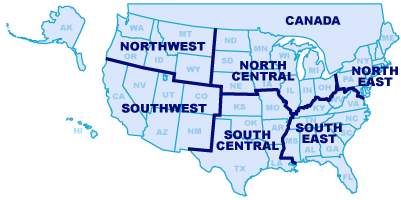
Click on the map below to bring schools in the selected region to the top of the list:







Articles on Literature:
A Future with a Literature Degree
By Calli Wolfenden, Staff Writer
Literature tells the stories of generations, culture, and humanity. Through literature, we find reflections of cultural values and standards. We see the rise and fall of heroes, the slaying of monsters, the solving of centuries-old crimes, and gain insight into the people behind the pages. Literature has the ability to take us back in time and look through different cultural lenses, as every culture has literature throughout its history, marking its changing atmosphere and social climate, reflecting its wins and losses, and showing how it is shaped by time. To dive into literature is to empathize with humanity, both in fiction and non-fiction.
Choosing to major in literature from a Christian college extends the study of literature toward a Spiritual application. Not only will you be able to study world literature and dive into the diverse cultural heritage and historical impacts seen in various cultures through their literature, but you’ll be invited to apply your literary analysis skills to the study of scripture. You’ll be able to read scripture with a newfound empathy and see details, patterns, and the beauty of the writing from a new perspective. A Christian college gives you the opportunity to grow spiritually, fall in love with the creativity and elegance of God, and understand his word on a deeper plane while obtaining your literature degree.
List of potential careers for someone who chooses to major in literature:
- Novelist: A Novelist writes long-form works of fiction that are meant to entertain or convey meaning. They develop characters, plot, conflict, and craft a story or narrative that will engage an audience. Their work may require in-depth research and lots of creativity to produce successful result.
- Public Relations Specialist: A Public Relations Specialist is in charge of maintaining or improving the company’s reputation. They work to create a positive public image through communicating achievements, good works, community engagement, or other good things with the press, social media, or other public outlets. They also handle crisis management for negative events or bad publicity, working to minimize the damage to the company/client’s image.
- Journalist: A Journalist’s main job is to inform the public about current events or trends as accurately as possible. They do this by conducting interviews, research, and investigations and compiling the accounts and presenting them as objectively as possible. They must adhere to ethical standards and verify their sources of information. Their work may be presented in a variety of mediums, such as newspapers, radio, or television, among others.
- Editor: An Editor reviews, edits, and polishes content before publication to ensure that the work meets a certain standard, style, or vision. Editors check for things like grammar, spelling, creative choices, tone, and may even fact-check and verify sources and information, depending on the kind of content.
- Content Writer: Content Writers craft written content that is targeted for a specific audience or purpose. Their work usually involves a combination of optimization for SEO, research, and creativity to meet their goals. They create content for blogs, social media, websites, campaigns, and many other mediums.
- Policy Analyst: Policy Analysts analyze the effectiveness of regulations, laws, and research public issues to inform lawmakers, organizations, and government entities. They propose solutions to issues of the public or issues with policies through collecting and interpreting data based on the effectiveness of current policies. They present their findings and recommend solutions through briefs or reports.
- Marketing Coordinator: Marketing coordinators oversee marketing initiatives, organize promotional activities, and manage social media and website presence. Their work often involves researching market trends and analyzing results and effects from previous or current marketing strategies implemented at the company.
Placement rates for Literature majors are difficult to pin down, however it is believed that the unemployment range is just about on part with the national average. Many graduates with an English or literature degree settle for employment unrelated to their major, but that does not mean their skills and knowledge are unused. A literature degree offers sharp communication, analysis, and creativity skills that are coveted in many career fields. The average annual salary for someone with a literature degree is around $52,000-58,000, which reflects the compensation across a wide variety of career fields. In any case, if your heart is set on a career within or surrounding literature, writing, and content, then there are some key strategies to employ in college to bolster your professional profile and give you an edge in the job market.
First, tailor your education to meet your career goals. Consider double majoring to develop skills that are adjacent to your major or beneficial to your desired career. If you plan to go into marketing, a minor in graphic design or business will make you highly desirable and give you the necessary skills to excel in that industry. A double major that includes technology gives you a leg up on almost any career field in the modern world. So much of how work gets done these days involves technology, so a minor or double major that teaches you technological skills such as coding, web programing, cyber security, or website building can significantly broaden your career prospects.
Invest in relevant experience and internships. Employers prioritize candidates with job experience for the role they are hiring. It shows that you are not only committed to the career, but that you also have base level experience doing the job and working with others. Make sure that you do at least one internship during your college years, and that you pay attention, you learn, you ask questions, and make a strong impression as a determined worker and quick learner. Leave behind a reputation that is easy to brag about, and network with the people you intern with. These contacts can be highly valuable for recommendations or job opportunities later on. Don’t forget to network with your professors, peers, and professionals that you meet in various settings as well. You never know who could recommend you for a job or let you know about one before it’s ever posted.
Keep a portfolio of writing samples. Whether from your classes, from internships, or even from personal projects, compile samples from your best work that show your skills and range. Many employers, specifically for roles that involve writing, will want to see what your writing looks like and a common way to do that is by asking for samples or a portfolio. You can keep these in a folder or create a personal blog with your best works posted.
One of the greatest virtues of the Literature degree is the honing of skills in communication, analysis, and critical thinking. The degree involves a lot of reading and synthesizing of information and then forming arguments in support of your analysis. This nurturing of critical thinking and communication skills is incredibly valuable for future career roles. Being able to clearly and concisely deliver messages or information in a persuasive way is a necessary skill in any career, especially one having to do with literature and writing. Creativity is also a necessary and practiced characteristic for those who choose to major in literature. Being able to find new and engaging ways to communicate and share information sets apart great writers from the good ones. The combination of these skills and traits prepares someone for careers in media, business, publishing, and even ministry.
Work Cited:
- “Salary: English Degree (July, 2025) United States.” ZipRecruiter, July 2025, www.ziprecruiter.com/Salaries/English-Degree-Salary.
- Gatta, Mary, et al. “Starting Salary Projections for Class of 2022 New College ...” NACE, 2022, careers.unc.edu/wp-content/uploads/2022/02/NACE-Salary-Survey_Winter-2022.pdf.
A Literature Degree and Ministry
By Calli Wolfenden, Staff Writer
The Bible is the greatest work of non-fiction literature to ever exist. It tells the true story of God, His love, and our redemption through His grace. Understanding how to analyze Scripture, how to dig deeper into the text, and how to communicate the truth effectively.
Romans 15:4
“For everything that was written in the past was written to teach us, so that through the endurance taught in the Scriptures and the encouragement they provide we might have hope.”
John 20:31
“But these are written that you may believe that Jesus is the Messiah, the Son of God, and that by believing you may have life in his name.”
There is a lot of use for writing, communication, critical thinking, and analysis in both church and ministry settings. The applications for someone with a literature degree are, therefore, many. From writing curriculum and newsletters for Churches and ministries, to working with pastors and theologians to write and edit sermons and books, the potential roles are varied and immensely important.
Beyond writing roles, someone with a literature degree can also serve in teaching roles, whether for children or adults, production roles, management roles, or, with additional education, pastoral roles. The analysis, research, and persuasion skills that are common parts of a literature degree are essential for the study and explanation of Scripture. The well-rounded nature of a literature degree opens multiple doors for participation in both a church setting and a ministry setting.
A literature degree prepares students for various career fields as the skills developed are highly sought after. Whether your goals are business, media, or even ministry, there is likely a role seeking someone with the skills of a literary genius. If you are a critical thinker, avid reader, strong communicator, and compellingly creative, then perhaps the Lord is calling you to pursue a literature degree!