Mathematic Christian Colleges
By clicking on the "Continue" and/or "Submit Request" button(s) on this form I am providing my electronic/ESIGN signature and agreement of expressed written consent to permit The Christian Connector, Inc. and the schools selected, and the parties calling/texting on behalf of the schools, to contact me at the phone number I provide for marketing purposes, including through the use of automated technology, SMS/MMS messages, and prerecorded/artificial/AI generated voice calls about education related opportunities. Message and data rates may apply. I understand that my consent is not required to obtain any goods or services from The Christian Connector or any of the colleges/universities. I acknowledge that I may select as many, or as few, schools as I wish to receive information from. I agree to the terms and privacy policy as well. I understand I can call 800-667-0600 to request information without providing any phone number.
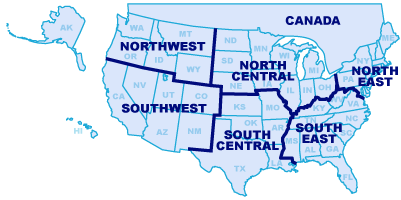
Click on the map below to bring schools in the selected region to the top of the list:







Articles on Mathematics:
A Future with a Mathematics Degree
By Calli Wolfenden, Staff Writer
Mathematics is in everything. The way we measure, the way we build, the way we design all hinges on our numeric language. Without it, organization goes by the wayside and chaos ensues. Now, of course, not everything we do with math is incredibly complicated, but we do all use it every day. And for those whose brains lock in on numbers and equations to find solid solutions, and who are programmed to perform with logical accuracy, a mathematics degree can take their innate skills and put it to impactful use.
Choosing to major in mathematics at a Christian university allows you to study your passion while holding outward appreciation for the order, organization, and intentionality God placed in creation. You have the opportunity to being challenged in your craft and discuss how mathematics intertwines with Biblical truth. The opportunity to grow both spiritually and career-wise is presented centrally at Christian colleges, offering you an experience tailored to your Faith.
List of potential careers for someone who chooses to major in mathematics:
- Mathematician: Mathematicians study mathematical principles, theories, and techniques, and find new ways to apply them or enhance them, as well as developing new theories through their research. Their role can influence fields such as engineering, science, technology, and much more. Ideally, their research and work in mathematics helps them and others to better understand the world around them and solve problems within it.
- Statistician: Statisticians collect data and analyze it to solve problems and provide data-driven support for decisions. They gather data using surveys, designed experiments, or studies, and through statistical methods, mathematical techniques, and software tools, they draw conclusions or create predictive models to forecast outcomes.
- Economist: An economist studies how resources are allocated by individuals, governments, or businesses to meet needs or wants. They analyze data and may be able to predict economic outcomes from their research, which can be used to advise on strategies, policies, or solve problems having to do with limited resources or poverty.
- Financial Analyst: A financial analyst evaluates financial trends and market data to help their clients make informed investment decisions. They may also prepare reports and forecasts and make recommendations for investment strategies or financial planning.
- Engineer: Engineers of all kinds rely on mathematics, though the exact application of it depends on the specific field of engineering. Engineers create solutions to real-world problems, be that through designing machines, programs, structures, and more. The work of engineers can be seen all around us, in nearly every field of work, as their creations are constantly being used and updated.
- Actuary: Actuaries play big roles in helping clients, agencies, or governments make sound financial decisions by assessing the risk to a decision using mathematics, economic theories, and statistics. They evaluate the potential cost of risks and the likelihood of events occurring through analyzing data, which is then used to come up with policies and strategies to mitigate potential financial losses. They often work in insurance or investment sectors.
- Cryptographer: Cryptographers are professionals who apply mathematic principles and algorithms to create secure communications and programs. The purpose of their work is to protect private information in communication or documents or other forms from being viewed by unauthorized sources. They may design and build or test out existing systems to ensure their efficacy. Their work is used in banking, security, cyber security, and even government agencies.
While specific numbers for nation-wide placement rates are not available, many schools boast of high percentages for their mathematics degree holders. The skills gained through a math degree are highly desirable to employers and companies of all kinds, meaning that the potential career path for someone with a math degree is wide open. Because there is such a wide variety of potential career paths, the average salary for someone with a mathematics degree ranges from around $56,000 to $62,000, though the Bureau of Labor Statistics puts the median salary for this degree at around $86,000. While the opportunities are certainly out there, many of them may require knowledge beyond just “math.” Here’s what you can do while you’re in college to best set yourself up for the career you want:
Most math-related careers involve technology, whether that be accounting, programming, and even teaching. Becoming proficient with technology is key to preparing yourself for the workforce. Consider learning programming languages, or even minoring in computer programming, to bolster your skillset and make you more marketable to potential employers.
Build up your “experience” through internships, research opportunities in fields you’re interested in, mathematics clubs/student and professional organizations, and personal projects that use mathematics to build something. Ideally, prioritize internships and research opportunities through your college or professional organizations. These will hold the most weight with future employers when they consider your experience. Opportunities like these also give you the chance to sample the career or practice and see how you like it, how each day might look, and give you an idea of what skills you may need to develop further or prioritize.
Networking through your professors, peers, and superiors/co-workers from your internships is also crucial. Keep these connections, and don’t be afraid to reach out to them when you’re looking for your next opportunity. You never know who the difference-maker in your employment status might be. These may be the people who inform you of job openings before they are ever posted or whose recommendation puts you ahead of the rest of the candidates.
Some key characteristics that help one succeed with a math degree are, naturally, critical and analytical thinking. Logic and persistence are core personality traits for those who choose to major in mathematics, as working through problems until they are solved can be tedious and time consuming. Technology and mathematics are commonly intertwined in today’s working world, which means that having proficiency with both numbers and computers is important. And, as we’ve heard many times, communication is key; much of the work you’ll do, either for clients or coworkers, will need to be explained, which means knowing how to take complicated or technical concepts and explain them in simpler terms. With this combination of characteristics, experience, and dedication, an individual would be well suited to any number of careers in business, research, and even ministry.
Work Cited:
- Bureau of Labor Statistics, U.S. Department of Labor, Occupational Outlook Handbook, Field of degree: Mathematics, at https://www.bls.gov/ooh/field-of-degree/mathematics/mathematics-field-of-degree.htm (visited August 28, 2025).
- College Data Analytics Team. “2025 Mathematics & Statistics Degree Guide.” College Factual, College Factual, 17 July 2025, www.collegefactual.com/majors/mathematics-and-statistics/.
A Mathematics Degree and Ministry
By Calli Wolfenden, Staff Writer
Luke 14:28, 31
28 “Suppose one of you wants to build a tower. Won’t you first sit down and estimate the cost to see if you have enough money to complete it? … 31 Or suppose a king is about to go to war against another king. Won’t he first sit down and consider whether he is able with ten thousand men to oppose the one coming against him with twenty thousand?”
Psalm 90:12
“Teach us to number our days, that we may gain a heart of wisdom.”
Someone who is good with numbers, logical reasoning, and is persistent in their work can fill any number of roles in a church or ministry organization. One of the most prominent examples of this is a role involving finance or logistics. Both churches and ministries have to handle money, work out how it’s used, and deal with things like salaries, bills, donations, and so on. Someone with a mathematics degree can be instrumental in organizing, tracking, and allocating money responsibly. Additionally, tracking impact, organizing volunteers, and keeping records of measurable activities or engagement with websites or attendance is another way that those who major in mathematics can use their expertise.
Additionally, the analytical skills that come from a mathematics degree can be beneficial for the analysis of Scripture and context, and teaching. Whether for Sunday school, theological research, or perhaps instructing students in a Christian schooling environment, there is potential for teaching or evangelizing for those with a mathematics degree.
Those who choose to major in mathematics have the potential for multiple career paths stretching across all sorts of impactful fields. If you are someone who is wired logically, enjoys numbers and definitive solutions, and has a knack for working with technology, then maybe the Lord is calling you to pursue a mathematics degree!