Pre-Dentistry Programs at Christian Universities
By clicking on the "Continue" and/or "Submit Request" button(s) on this form I am providing my electronic/ESIGN signature and agreement of expressed written consent to permit The Christian Connector, Inc. and the schools selected, and the parties calling/texting on behalf of the schools, to contact me at the phone number I provide for marketing purposes, including through the use of automated technology, SMS/MMS messages, and prerecorded/artificial/AI generated voice calls about education related opportunities. Message and data rates may apply. I understand that my consent is not required to obtain any goods or services from The Christian Connector or any of the colleges/universities. I acknowledge that I may select as many, or as few, schools as I wish to receive information from. I agree to the terms and privacy policy as well. I understand I can call 800-667-0600 to request information without providing any phone number.
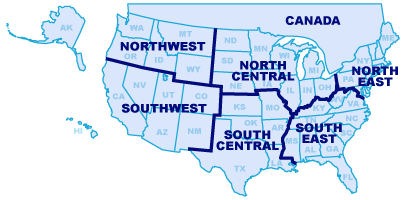
Click on the map below to bring schools in the selected region to the top of the list:






Articles on Pre-Dentistry:
A Future in Dentistry (Pre-Dentistry)
By Calli Wolfenden, Staff Writer
Pre-dentistry programs are the undergraduate degrees that prepare students for dental school. But that doesn’t necessarily mean they have to be “about” dental school. Technically, you can major in anything you want as part of a pre-dentistry program, you just have to complete certain classes as part of your required pre-requisites for the dental school(s) you want to attend. Outside of that, you can be a biology major, or a theater major. You can study languages, or the environment. What makes a program “pre-dentistry” is the prerequisite classes, the extracurricular experience, and the academic advising directions that you take to gear you toward dental school after your bachelor’s degree.
Choosing to pursue a pre-dentistry program at a Christian college allows you the same freedom in your studies while also giving you clear and intentional guidance in your academic advising and preparation for dental school. You will supported academically and spiritually, as your environment is built to nurture and encourage your relationship with Christ. Not only will you be prepared for dental school, but you’ll be supported in your faith, preparing you to also step into a scientific field as a Christian.
A list of careers for someone who chooses a pre-dentistry program:
- Dentist: A dentist is a health professional who works on the health of the teeth, gums, and mouth, diagnosing, treating, and helping prevent diseases or health problems. Some duties of a dentist include examining patients, taking X-rays, doing procedures like cleanings, fillings, tooth extractions, crowns, and creating treatment plans for patients to restore health and wellness. They may also educate patients on proper care, flossing, brushing, and how to best prevent oral disease and promote health.
- Dental Hygienist: Dental hygienists’ work is largely focused on prevention, as they clean teeth of plaque, tartar, and stains and look for any signs of gum disease or other similar problems. They may also take X-rays, apply sealants or fluoride treatments, and educate patients on proper dental care and upkeep to ensure health and wellness.
- Dental Lab Technician: Dental lab technicians typically work in labs rather than with patients and create dental appliances for patients based on a dentist’s specifications. They make items like dental crowns, dentures, bridges, and other important appliances that restore or improve patients’ oral health, function, and appearance.
- Endodontist: Endodontists are experts on the inside of teeth, their structure, their health, and pain management due to issues or infections with the inner structure of teeth. They are highly trained for procedures that remove infections from inside of teeth, preserving the original tooth to the best of their ability, and bringing relief from pain and restoring health. Their role requires additional training beyond dental school.
- Oral and Maxillofacial Surgeon: An oral and maxillofacial surgeon is a health professional who performs surgery on the mouth, jaws, face, and teeth. Common surgeries they perform are wisdom teeth removal or dental implant surgeries; however they also treat impacted teeth, facial injuries, or jaw disorders as well. Their work requires additional education after dental school and is essential for restoring function, health, and relieving pain.
While there are no available national average placement rates for a pre-dentistry program or for graduates from dental school, the field of dentistry is believed to be very prosperous, with a low unemployment rate of 0.9% as of 2024. Additionally, the average annual salary for dentists is quite high at around $179,210 per year, showing the strong financial reward for the field. With so much promise in the field of dentistry, there is likely to be high competition. So, what can you do while still in college to give yourself the best chance for success in a pre-dentistry program?
The first thing to understand about a pre-dentistry program is that it is not a major by itself. Pre-dentistry is more like a set of prerequisites that you need to meet in order to be admitted into dental school, but the actual major it not necessarily relevant. As long as you take the required classes for the dental school(s) that you want to attend, it doesn’t matter what you major in. Many pre-dentistry students choose biology, chemistry, or some major in the science field because it involves most of their prerequisites anyway, but you can choose anything as long as you still complete those required classes. Each dental school will have their own list of required prerequisites, so be sure to do your research early so you know how to prepare yourself for dental schools you want to attend. You’ll also need to maintain a strong GPA, no less than 3.5, to be eligible for dental school. Being on top of your studies and classes is essential for succeeding with a pre-dentistry program.
Shadowing a dentist is also an important step. It’s not just a “good idea,” it’s a requirement. Seeing how the work is done and having an expert give you advice, tips, and answer your questions through real-time exposure is incredibly valuable to your development in the industry. It also gives you a chance to see if you’d actually do well in the environment and enjoy the work by giving you a dose of the experience. Be sure to take notes during your shadowing experience, jot down questions to ask when you’re not around patients, be careful to follow all the dentist’s rules, and come prepared (i.e. if they ask you to wear a certain color of scrubs or certain shoes, have those ready before your first day). Many dental schools require a letter of recommendation, so be sure to connect with the dentist you are shadowing and put your best foot forward so they will have plenty of good things to say about you. Keep an active network of people you meet in the industry, dentists you shadow, and peers/professors—you never know what connections will pay off in the future.
If you want a career in dentistry, the Dental Admission Test (DAT) is in your future. You should plan to take it at the end of your junior year of college, or at least a year before you plan to attend dental school. The DAT, scored on a range of 200-600, is a huge part of determining your eligibility for dental school, so you’ll need to use study materials, take practice tests, review notes from your required prerequisite classes, and do whatever you can to prepare for it as best you can. While there isn’t necessarily a “passing” score, you want to aim for a score above 400, with a top or competitive score being around 450 or higher. Each school determines its acceptable score range, so be sure you know what is expected for your top schools. You can retake the DAT up to three times to boost your score if needed, but you have to wait at least 90 days between each attempt, which can push your attendance timeline back if you have to retake it multiple times. Ideally, you’ll want to get great scores the first time.
Steady hands, attention to detail, and sharp focus are necessary characteristics for someone pursuing dentistry, as you’ll likely spend a long time with one patient and tools in hand. You’ll need to be able to be precise with various tools, careful not to bump or hit anything but what you’re working on. Different procedures vary in time, so you’ll need to be able to focus on one procedure, one person, or one issue for potentially several hours at a time. Being a committed life-long learner is essential, as you’ll need to keep up-to-date on best practices, new treatment options, new technology in the field, and new discoveries. Collaboration and teamwork skills will come in handy, as you’ll have to work with other dentists, assistants, and office workers throughout the treatment of patients. Compassion and empathy are also needed as you’ll work with many patients with pain, frustration, or fear who will respond better to someone who can listen and show care for their situations. Being a strong communicator is also part of the role, as you’ll be explaining potentially complicated diagnoses or treatment plans to patients, so you’ll need to translate it into clear layman’s terms that can be simply understood. Someone with a combination of these characteristics along with technical and scientific prowess would be a strong fit for a career in dentistry, whether in a private practice, larger company, or in ministry.
Work Cited:
- “Understanding DAT Score Percentiles: Dat Destroyer.” Orgoman LLC, 3 Oct. 2025, orgoman.com/blogs/dental-admissions-test-and-road-to-dental-school-acceptance/dat-percentiles-how-to-interpret-your-score-and-improve-your-chances.
- Bureau of Labor Statistics, U.S. Department of Labor, Occupational Outlook Handbook, Dentists, at https://www.bls.gov/ooh/healthcare/dentists.htm (visited March 13, 2026).
- Stott, Dr. Jason. “20+ Interesting Dental Career Statistics and Trends.” Open & Affordable, Open & Affordable, 9 Oct. 2025, www.openandaffordable.com/post/dental-career-statistics-and-trends.
Dentistry and Ministry
By Calli Wolfenden, Staff Writer
Matthew 10:8
“Heal the sick, raise the dead, cleanse those who have leprosy, drive out demons. Freely you have received; freely give.” (NIV)
1 Corinthians 15:58
“Therefore, my dear brothers and sisters, stand firm. Let nothing move you. Always give yourselves fully to the work of the Lord, because you know that your labor in the Lord is not in vain.” (NIV)
Someone who completes a pre-dentistry program and pursues a career in dentistry can be a valuable part of ministry, whether in missions or the local church. They can partner with their church community and local community to offer hosting “dental clinic days” and invite members of the church and local community to get basic dental services and in that way extend the love of Christ. They could also take that ministry on wheels, offering that service at different churches, to help them connect with their communities and present Christ in meeting others’ basic needs.
Mission work is another great way that someone who is pursuing a career in dentistry can minister to others. Medical missions, dental missions, or even just short- or long-term missions trips are a great way for individuals to educate others not just about proper dental care, but also about Jesus. They can provide a healing hand, relieve pain, and aid in increasing wellness across the globe while also serving as an example of God’s love and using it as a platform to tell other’s about Him. The opportunities available in ministry and the church for someone trained in dentistry are quite remarkable.
Dentists may not always be loved, nor is going to the dentist a favorite errand, but the value of dentistry is clear and powerful. If you are someone who loves science, helping others, has sharp focus, good teamwork skills, is a strong communicator, and is a dedicated life-long learner, then perhaps the Lord is calling you to pursue a pre-dentistry program!