Christian Colleges with Pre-Pharmacy
By clicking on the "Continue" and/or "Submit Request" button(s) on this form I am providing my electronic/ESIGN signature and agreement of expressed written consent to permit The Christian Connector, Inc. and the schools selected, and the parties calling/texting on behalf of the schools, to contact me at the phone number I provide for marketing purposes, including through the use of automated technology, SMS/MMS messages, and prerecorded/artificial/AI generated voice calls about education related opportunities. Message and data rates may apply. I understand that my consent is not required to obtain any goods or services from The Christian Connector or any of the colleges/universities. I acknowledge that I may select as many, or as few, schools as I wish to receive information from. I agree to the terms and privacy policy as well. I understand I can call 800-667-0600 to request information without providing any phone number.
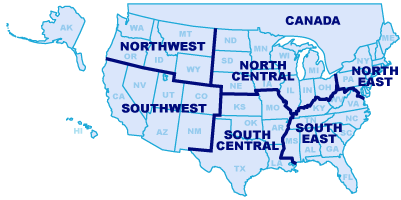
Click on the map below to bring schools in the selected region to the top of the list:







Articles on Pre-Pharmacy:
A Future with a Pharmacy Degree (Pre-Pharmacy)
By Calli Wolfenden, Staff Writer
We can all think of a time when medicine has helped us with an issue, from something as small as ibuprofen for a headache and cough syrup for a cold, to perhaps a life-saving treatment plan for cancer. Medication, in its many forms, falls under the field of pharmacy. Its purpose is to heal, to repair, and to manage symptoms of illness, inflammation, or diseases. By extension, the role of a pharmacist is to help people safely take medicine that is right for them in whatever situation they have to promote healing and wellness.
Choosing to pursue a pre-pharmacy program at a Christian college combines the goal of healing and helping people with faith in God and the understanding that all were made in his image. A Christian college provides pre-pharmacy students with the opportunity to study in a science-intensive field with biblical truth and faith intertwined into their education. Spiritual nurturing and educational excellence are woven together to impactfully prepare them for their career and life.
A list of potential careers for someone who pursues a pharmacy degree:
- Community/Retail Pharmacist: A community/retail pharmacist is someone who fills prescriptions at a Pharmacy or “drug store,” such as CVS Health or Walgreens. They work with Doctors and sometimes insurance companies to provide patients with the right medications and ensure that they are covered under their policies. Providing services like vaccinations and health screenings may also fall under their purview, but most of their responsibility is in filling a prescription, explaining the dosage, possible side effects, and drug interactions to a patient to ensure they know how to properly take their medicine.
- Hospital Pharmacist: A hospital pharmacist is a pharmacist who works in a hospital, filling prescriptions set by doctors and handling the medications and dosages given to patients in their care. They work closely with doctors, nurses, and sometimes patients, as they will occasionally monitor patients on medications to track side effects, drug interactions, and make changes as necessary.
- Pharmaceutical Sales Representative: Pharmaceutical sales representatives educate doctors, pharmacists, and medical staff on the pharmaceutical products and medications that they are selling and why they are beneficial. They are informed about the biochemical makeup of the drug, how it works in the body, and what sort of chemical reactions bring about it’s effects. They act as the bridge between pharmaceutical companies and the healthcare industry that uses them.
- Pharmacologist: Pharmacologists are medical scientists who focus on the testing and development of chemical drugs. They explore how the drugs affect the living things taking them, what possible side effects there may be, and what sort of likelihood there is of someone becoming addicted to the drug. They work in research teams and develop the drugs that pharmacists then distribute.
- Toxicologist: A toxicologist is a research professional who studies substances or chemicals to determine if they are toxic to living things and what effects they may have. They may study natural or man-made poisons. They also study things that may be harmful to the environment, test water supply, and may weigh in on the safety of certain products, such as cosmetics or cleaning products.
- Military Pharmacist: A military pharmacist is a pharmacist who works with service members, veterans, and occasionally their families, filling prescriptions, advising them on proper medication use and dosage, and warning them of potential side effects and drug interactions for their medications. They may work out of military hospitals, facilities, or potentially on deployments for any of the military branches.
National placement rates for those who get their Doctor of Pharmacy degree are not readily available, however the pass rate for the NAPLEX (North American Pharmacist Licensure Examination) is quite high, at around 86.8% as of 2025. With an average annual salary of around $137,480, and the opportunity to help others find solutions to their health problems, the reward for a career as a pharmacist is quite clear. Such promise in a career often means strong competition. So, what should you be doing in college to give yourself the best chance of succeeding with a pre-pharmacy program?
The first area you’ll need to focus on is your prerequisites. Most pharmacy schools want to see an array of science classes, math classes, and some English and communication/public speaking classes. It’s important to note that not every pharmacy school has the same perquisites. So, while biology, chemistry, and calculus are likely on the list for every pharmacy school and are a good idea to take, you may need public speaking and not communication. For that reason, it’s important that you start researching different pharmacy schools early and make a list of the ones you are most interested in so that you can ensure you take the prerequisites they require. Your grades in these courses are also going to matter. You’ll want to maintain an overall GPA of at least 3.0, but ideally higher, in order to be competitive in the admissions process.
Meet consistently with an academic advisor during your undergraduate career. This will help you keep track of your progress toward your pharmacy school goals and ensure that you are completing all the prerequisite classes with acceptable grades. Your advisor will also be able to give you advice for additional courses to take that may appeal to pharmacy school admissions as well as strategies for keeping up or raising your grades. They may even be able to suggest extracurriculars or potential internships/jobs that will buff up your application to give a leg up on other candidates. Ideally, you should meet with your academic advisor every semester.
Depending on the pharmacy schools you are aiming for, you may also be required to have experience working in a pharmacy setting. Even if the schools do not require that of their applications, it’s still a smart idea to prioritize experience like that and include it in your application. If you can get an internships, or a pharmacy technician job, it will look great on your application, provide you with contacts working in the field who can speak to your character and what you’ve learned, and give you a taste of the profession to begin sharpening the skills required to excel as a pharmacist. If you can’t get an internship or job, volunteer work that involves working with patients in some way will also give you great exposure to the health-care world and look good on applications. To find out what each school requires of applicants, you can look schools up on PharmCAS.org, which is used as an application vendor by many pharmacy schools and will show you application requirements and prerequisites.
A career as a pharmacist requires great communication skills, as you’ll be working with doctors, insurance companies, and patients, explaining the proper way to take certain medications, the potential side effects, and drug interactions to ensure their safety and wellbeing. Pharmacists deal with strong, potentially dangerous drugs and substances that can be heavily addicting, so integrity and strong attention to detail are required, as mistakes can have big consequences for patients’ health. Patience and compassion are also key characteristics, as you’ll likely be working with patients all day who are dealing with various issues that can lead to frustration in their conversations with you, so it’s important you are able to empathize and remain calm and effective in your communication. These are just a few of the necessary characteristics that will help you succeed with a career as a pharmacist, whether in a hospital, drug store, or in ministry.
Work Cited:
- Bureau of Labor Statistics, U.S. Department of Labor, Occupational Outlook Handbook, Pharmacists, at https://www.bls.gov/ooh/healthcare/pharmacists.htm (visited April 15, 2026).
- “Admissions.” Admissions | Pharmacy Is Right for Me (Pharm4me), pharmacyforme.org/admissions. Accessed 1 May 2026.
- “Pre-Pharmacy Prep.” PharmCAS, www.pharmcas.org/helpful-resources/pre-pharmacy-prep. Accessed 1 May 2026.
- “Passing Rates for 2023-2025 Graduates.” NABP, 16 Mar. 2026, nabp.pharmacy/wp-content/uploads/NAPLEX-Pass-Rates.pdf.
A Pharmacy Degree and Ministry
By Calli Wolfenden, Staff Writer
Galatians 6:10
“Therefore, as we have opportunity, let us do good to all people, especially to those who belong to the family of believers.” (NIV)
Luke 10:9
“Heal the sick who are there and tell them, ‘The kingdom of God has come near to you.’” (NIV)
The purpose of pharmacy is to promote health and wellness, taking care of the bodies that the Lord has given us. A pharmacist can provide a valuable perspective in both the church and in ministry, as they can support faith-based clinics and missions trips. Whether it is a ministry that’s local or traveling abroad, a pharmacist can provide their expertise on proper ways to treat certain illnesses or issues and also make referrals where needed. For faith-based clinics or ministry clinics, they can be a partner that fills prescriptions and supports the doctors and patients through advising on treatment options.
Pharmacists can also be a beneficial member of medical missions, as they bring with them knowledge of medication, drug interactions, side effects, and different treatment options. They can provide some medical treatment and medication therapy to those they minister to while also sharing the gospel and being an example of the love of God in caring for those around them. There are many opportunities for someone with a pharmacy degree to showcase the love of God and minister to others in an impactful and healing way.
A career as a pharmacist offers the opportunity to help and impact the lives of others in potentially life-saving ways. If you are passionate about helping others, caring, patient, a strong communicator, a fan of science, and full of integrity, then perhaps the Lord is calling you to pursue a pre-pharmacy program!