Pre-Vet majors at Christian Colleges and Universities
By clicking on the "Continue" and/or "Submit Request" button(s) on this form I am providing my electronic/ESIGN signature and agreement of expressed written consent to permit The Christian Connector, Inc. and the schools selected, and the parties calling/texting on behalf of the schools, to contact me at the phone number I provide for marketing purposes, including through the use of automated technology, SMS/MMS messages, and prerecorded/artificial/AI generated voice calls about education related opportunities. Message and data rates may apply. I understand that my consent is not required to obtain any goods or services from The Christian Connector or any of the colleges/universities. I acknowledge that I may select as many, or as few, schools as I wish to receive information from. I agree to the terms and privacy policy as well. I understand I can call 800-667-0600 to request information without providing any phone number.
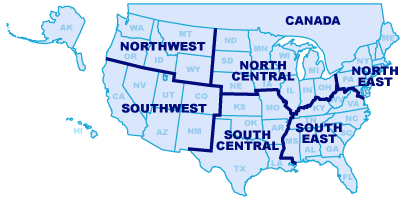
Click on the map below to bring schools in the selected region to the top of the list:







Articles on Pre-Vet:
A Future with a Veterinary Degree (Pre-Veterinary)
By Calli Wolfenden, Staff Writer
In the beginning, stretching back to creation, God created man, in His image, and animals, to be under the dominion of man. Since that time, animals have served as various kinds of companions for man, whether that be in work, in service, or in friendship/family. In these roles, God calls us to stewardship over animals, from feeding them and preventing cruelty toward them to caring for them and their health needs. This is where Veterinarians come in. Veterinarians care for animals medically, diagnosing, treating, and providing emergency care for animals of all kinds, from pets to predators, and everything in between.
Choosing a pre-veterinary program at a Christian college prepares students for the academic intensity of veterinary school, while also nurturing their relationship with the Lord. The building of their faith prepares them for life as a whole, and a Christian college education can help them understand the importance of caring for animals in terms of both stewardship over a gift from the Lord and love.
A list of potential careers for someone who chooses to pursue a veterinary degree:
- Veterinarian: Veterinarians are medical professionals who work with animals, diagnosing, treating, and helping to prevent injuries and illnesses in pets, livestock, service animals, and more. They may also educate pet owners about proper care and how to spot health issues in their pets.
- Large Animal Veterinarian: Large animal veterinarians specialize in caring for large animals, usually farm and ranch animals, such as sheep, cattle, horses, pigs, and more. Often traveling to farms, stables, and ranches to provide care on-site, they treat and diagnose illnesses, injuries, give vaccinations, assist with births and reproductive issues, and give advice on managing health and nutrition.
- Exotic Animal Veterinarian: Exotic animal veterinarians provide care for nontraditional pets (like birds, reptiles, rabbits, and amphibians) and wildlife, even sometimes working for zoos, aquariums, or wildlife rehab centers. They treat and diagnose illnesses and injuries, perform surgeries, assist with birthing (mostly for larger animals), and advise on proper diet and care for the different animals.
- Zoologist: A zoologist studies animals specifically, conducting research on their behavior, physiology, interactions with each other and their environment, and their classification. Zoologists study animals both in their natural habitat, and in controlled environments, as well as studying the effect of human activity on wildlife and habitats. Because of this, much of their research contributes to conservation efforts and education.
- Military Veterinarian: A military veterinarian works/serves with the Military and cares for animals in the military, such as working dogs and horses. They monitor their health, diagnose and treat illnesses and injuries, perform surgeries, and inspect and monitor their food and nutrition. Military veterinarians may work on military bases in the US or abroad.
The placement rates for graduates of veterinary school are believed to be quite high, though specific statistics on a national level are not readily available, though specific colleges do post their own placement rates. With an average salary of around $125,510 and the opportunity to work with animals, it’s easy to see the appeal and reward of a career as a veterinarian. With great reward one can also expect high competition, so what can you do while still in college to give yourself the best chance of succeeding with a pre-veterinary program?
Surprisingly, your major is actually not very relevant for veterinary school. What they care about are prerequisites and your grades. It’s important to note that not every veterinary school has the same prerequisites. So, along with focusing on your studies, you’ll need to sit down with your academic advisor early on in your freshman year and talk about which prerequisites you can get out of the way and what your best options are for veterinary school. Common prerequisites are biology, chemistry, biochemistry, mathematics, and English composition.
Another important area of focus is experience. With most college majors, internships are key. With a pre veterinary program, you aren’t necessarily looking for an internship as much as you are looking to shadow a vet. If that comes in the form of an internship or part time job, that’s perfect. But likely, it will just be a vet agreeing to let you observe their work, ask them questions, and learn. Most veterinary schools require hundreds of hours of shadowing as part of their application process, so be sure that you prioritize this throughout your undergraduate years.
Networking is a convenient and necessary byproduct of shadowing a vet, as you’ll likely need several recommendation letters for your veterinary school applications. Additionally, having a strong network of vets, professors, peers, and others in the industry will be highly beneficial when you’ve graduated vet school and are looking for job openings. Be sure to join Veterinary or animal-related societies or clubs around your college and during your pre veterinary program to build up some of these peer relationships for later on.
One of many challenges that a veterinarian deals with is that their patients don’t speak—they can’t explain their pain or their symptoms. So, great attention to detail, critical thinking, and problem solving are needed to determine what’s going on, diagnose, and find the best way to treat the animals in their care. Strong communication skills are necessary, as you’ll need to clearly explain to pet owners the diagnoses and options for treatment in a way that they can understand. Veterinarians, especially those working in an ER setting, can deal with high-stress situations, emotional/difficult pet owners and pets, and heavy decisions, so being cool under pressure is a key characteristic for a veterinarian. Additionally, compassion and patience are also important in order to provide the best care for animals and their owners. Someone with these characteristics will be well suited for a career as a veterinarian, whether in a private practice, a clinic, or in ministry.
Work Cited:
- “Home - Christian Veterinary Mission.” Christian Veterinary Mission, cvm.org/. Accessed 28 May 2026.
- “Summary of Course Prerequisites.” American Association of Veterinary Medical Colleges, 21 Jan. 2025, admin.applytovetschool.org/wp-content/uploads/2025/05/Prereq-chart-for-VMCAS-2026.pdf.
- Bureau of Labor Statistics, U.S. Department of Labor, Occupational Outlook Handbook, Veterinarians, at https://www.bls.gov/ooh/healthcare/veterinarians.htm (visited April 21, 2026
A Veterinary Degree and Ministry
By Calli Wolfenden, Staff Writer
Psalm 36:6
“Your righteousness is like the highest mountains, your justice like the great deep. You, Lord, preserve both people and animals.” (NIV)
Deuteronomy 22:4
“If you see your fellow Israelite’s donkey or ox fallen on the road, do not ignore it. Help the owner get it to its feet.” (NIV)
A veterinarian can be a surprising ministry role, as the patients are animals and not people, however, the role of serving others, showing compassion, and opening doors through reflecting the love of God remains at the forefront of what a Christian veterinarian does. While it may not be common, serving in missions as a veterinarian allows you to serve whole communities, some who may be dependent on agriculture and livestock, caring for their animals and teaching them to do the same. This can give the opportunity to evangelize, as you represent Christ through your actions and character. A great example of this kind of ministry is the Christian Veterinary Mission.
Even if you stay local, you can still make an impact by opening your own private practice and connecting with the community or local farmers through outreach projects and animal clinics. Caring for people’s pets and livestock is a great way to build trust and open up opportunities to share the gospel or even just your testimony. You never know how just the action of caring for something someone else loves or just talking about your own experience can be exactly what God uses to change someone else’s life.
Pursuing a pre-veterinary program and then a veterinary degree is a gateway into a life filled with life-saving impact. If you are compassionate, science-minded, patient, passionate about animals, a strong communicator, and cool under pressure, then perhaps the Lord is calling you to pursue a pre-veterinary program!