Christian Colleges For Psychology
By clicking on the "Continue" and/or "Submit Request" button(s) on this form I am providing my electronic/ESIGN signature and agreement of expressed written consent to permit The Christian Connector, Inc. and the schools selected, and the parties calling/texting on behalf of the schools, to contact me at the phone number I provide for marketing purposes, including through the use of automated technology, SMS/MMS messages, and prerecorded/artificial/AI generated voice calls about education related opportunities. Message and data rates may apply. I understand that my consent is not required to obtain any goods or services from The Christian Connector or any of the colleges/universities. I acknowledge that I may select as many, or as few, schools as I wish to receive information from. I agree to the terms and privacy policy as well. I understand I can call 800-667-0600 to request information without providing any phone number.
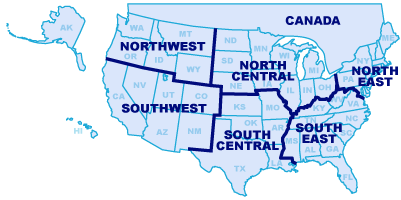
Click on the map below to bring schools in the selected region to the top of the list:







Articles on Psychology:
Explore a Major in Psychology
By Marsha Kearns
In a way, we are all interested in psychology, because we are all interested in ourselves and others: Why do we act the way we do? What do dreams mean? What causes mental disorders, and how can they be treated? What role does the unconscious mind play in reality?
These are some common questions that the study of psychology attempts to answer, but the questions and answers are endless because psychology continues to evolve as a discipline that essentially is a study of the mind. There are theories, beliefs, treatments, and changes in every field of psychology, so it is critical that you take a good look at your own beliefs, interests, and temperament as you consider a degree in psychology.
You will want to get at least a bachelor’s degree; many psychology majors go on to graduate degrees to pursue their passion. There are many options for career directions in the diverse areas of studying human nature, even with a bachelor’s degree. The major is extremely adaptable to . A counselor can help you sort through your choices and find the best match.
Look at a Career in Psychology
When you have a deep understanding of the mind and behavior of people, you’ll be able to translate those skills into a wide variety of jobs, including such things as marketing, social services, and case management. Your research and writing ability will come in handy in any position/career.
What you do in your career may depend upon choosing a specialty area, but you will most likely work in the broad areas of research psychology or applied psychology. Research psychologists spend time looking into the variable bases of human thought and behavior. They pose hypotheses and theories and conduct experiments. They may work at a university, for the government, or at a business.
Applied psychologists work directly with people to help them cope with real-life stress and problems. You’ll be more likely to work in a hospital, mental health clinic, school, or as a self-employed counselor. In other words, you will apply your skills in direct service to people. You’ll assess patients and diagnose disorders, often working closely with other professionals such as therapists, doctors, and nurses.
No matter which route you choose, your career in psychology will most likely be satisfying and rewarding, while at the same time challenging, stressful, and emotionally draining. You’ll meet a wide variety of new people and help them work through their own challenges and reach their goals.
Types of Skills/Attributes
- good communication skills
- interpersonal skills
- good listener
- analytical
- patient
- research skills
- compassion
- critical thinker
- curious
- objective
- even temperament
- writing skills
- organized
- empathetic?
Types of Jobs/Settings
- clinical psychologist
- forensic psychologist
- academic/career counselor
- health psychologist
- child psychologist
- case worker
- clinical psychologist
- corrections officer
- art therapist
- crisis counselor
- marriage counselor
- sports psychologist
- mental health researcher
- hospital
- school
- law enforcement
- industrial-organizational psychologist
- animal behaviorist
Self-Assessment
Do I want to learn more about myself and others?
Do I want to work directly with people?
Do I want to understand why people do certain things in certain circumstances?
Am I able to stay calm and objective under emotional stress?
Do I like to organize, analyze, and interpret data?
Do I want to help people solve problems and increase their well-being?
Am I interested in learning how the mind and body interact on many levels?
Am I willing to accommodate clients’ schedules, or do I prefer to work in a more predictable environment?
Am I willing to study and learn science and mathematics?
Am I willing to spend the time to become a licensed psychologist?
*If you answered “yes” to at least 7 of these questions, a major in Psychology might be right for you.