Christian College with Aviation Majors
By clicking on the "Continue" and/or "Submit Request" button(s) on this form I am providing my electronic/ESIGN signature and agreement of expressed written consent to permit The Christian Connector, Inc. and the schools selected, and the parties calling/texting on behalf of the schools, to contact me at the phone number I provide for marketing purposes, including through the use of automated technology, SMS/MMS messages, and prerecorded/artificial/AI generated voice calls about education related opportunities. Message and data rates may apply. I understand that my consent is not required to obtain any goods or services from The Christian Connector or any of the colleges/universities. I acknowledge that I may select as many, or as few, schools as I wish to receive information from. I agree to the terms and privacy policy as well. I understand I can call 800-667-0600 to request information without providing any phone number.
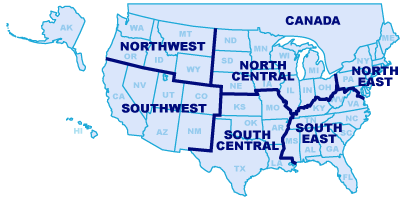
Click on the map below to bring schools in the selected region to the top of the list:







Articles on Aviation:
A Future with an Aviation Degree
By Calli Wolfenden, Staff Writer
Aviation encompasses the science and art of flying in the air. The field of Aviation is broad, with its scope stretching further than just piloting a plane wearing super fly aviator shades. Getting an aviation degree could mean learning to build, design, engineer, or pilot an aircraft. An aviation degree could also be the starting point to a career on the business end of flying, working with airlines or private contractors.
Getting an aviation degree from a Christian college puts into perspective the great detail the Lord has placed in creation and the abilities that He has given us. Not only will students learn the science of how a plane stays in the air and pushes through the sky, but their faith and understanding of the Lord’s reach will grow as well. To major in Aviation at a Christian college is to be dedicated to God and honing the incredible gift that he has given. An aviation degree will prepare students to make an immense impact on others, be it in the commercial, military, or missions’ field.
Some example careers for students who major in aviation:
- Commercial Pilot: Commercial pilots hold commercial pilot’s licenses and are “for Hire” or compensation. They transport people or cargo from one location to another via aircraft and are responsible for communicating with air traffic control and maintaining safety throughout the flight.
- Private Pilot: Private pilots hold a private pilot’s license and typically fly for personal or recreational purposes, not for compensation. They must know how to operate an aircraft safely and adhere to all aviation regulations. Typically, their journeys range from local flights to cross-country flights.
- Air Traffic Controller: Air Traffic Controllers manage the flow and order of aircraft on the ground for some type of runway (military, domestic/international airport). They communicate with the pilots, prevent collisions through keeping the flow organized, and provide instructions and guidance during emergency situations. They operate radar and communications equipment and also provide weather updates, takeoff, and landing instructions for pilots.
- Aerospace Engineer: An Aerospace Engineer designs and tests aircraft, spacecraft, satellites, and missiles, usually using applied principles of mathematics and physics. They develop new technology for aviation, defense systems, and space exploration, aiming to ensure safety, reliability, and efficiency.
- Aircraft Maintenance Technician: An Aircraft Maintenance Technician ensures the readiness to fly and safety of an aircraft. They inspect, maintain, and repair aircraft, being knowledgeable in various areas of the aircraft like engines, landing gear, and avionics. Aircraft Maintenance Technicians are certified professionals and must adhere to strict safety and standard regulations and guidelines.
- Flight Attendant: Flight Attendants provide in-flight assistance to passengers, ensuring the safety and comfort of all on board. They conduct safety briefings, pass out beverages and snacks/meals, provide customer service, and handle any on-board emergencies.
- Quality Control Personnel: Quality Control Personnel are responsible for maintaining high safety and performance standards in the industry of aviation. They inspect and monitor products and processes in manufacturing and maintenance and ensure that everything is operating properly and without defect or malfunction.
- Military: Military careers for students who major in aviation range from being a pilot for the Army, Navy, Airforce, or Marines to working aircraft maintenance, to operating unmanned aerial vehicles (UAV). The roles within operating aircraft for the Military could be transport, surveillance, or even combat, all of which involve different kinds of training and aircraft know-how.
It’s difficult to pin down placement or success rates for those with an aviation degree, however the field has a lot of potential. There is high demand for qualified pilots, engineers, and controllers, especially with air travel being as developed and popular as it is today. While determining the stats for success may not be doable, there are factors that contribute to becoming successful in the field of aviation. High on that list is continued education and acquired certifications. Holding a degree in aviation is not enough to get you behind the “wheel” of a plane. Pilots require certification and licenses before they are allowed to fly a plane full of people or packages. Before they can be certified, pilots must get a minimum of 1,500 hours of in-flight practice.
Continued education, depending on what sort of focus you want in your career, may be necessary or just encouraged, as it makes you more employable. Even after gaining whatever certification or licensure you need, continued education is needed so as to stay up to date on the latest technology and techniques. The business and engineering side of a degree are likely to seek individuals with degrees beyond a bachelor’s, so if that’s the path you desire, plan on further education.
Another key to a successful career in Aviation is networking. Even while in college, building up a network with your professors and connections through your school can do wonders for kickstarting your career after graduation. Getting started in any part of the aviation industry, be it as a pilot, engineer, or on the business side is much easier when you have someone familiar in your corner to vouch for you. It also comes in handy when they can recommend you for openings or entry-level positions within their network. Networking once you have a job also plays a key role in advancing your career and climbing the ladder down the line.
Starting salaries in the field of Aviation are also quite difficult to determine, as much of it depends on experience, area, company, and type of job. Commercial and Airline pilots make a median annual salary of about $171,210, but Airline pilots typically make more. Average annual pay for aircraft mechanics is around $76,260, but that is not the starting range. For graduates starting a career in aerospace engineering, the starting average salary is around $76,293. With the many career options stemming from a major in aviation, there is great variety in starting salaries and great potential for a beneficial career.
Aviators need to be composed and attentive to detail. They are great communicators and have excellent teamwork skills, as they often work with crews and copilots, or teams of engineers. To be a great aviator you need to be able to adapt quickly and problem solve on-the-spot. Their willingness to continue learning and their commitment to the safety of others, along with other noteworthy characteristics, makes them great candidates for not just commercial airlines or hangars, but also for mission work.
Works Cited:
- “Aerospace Engineers: Salary Guide.” What Is the Salary of Aerospace Engineers?, 17 July 2024, www.aviationjobsearch.com/career-hub/articles/career-advice/b1-engineer/aerospace-engineers-salary-guide.
- “Aircraft Mechanics and Service Technicians.” U.S. Bureau of Labor Statistics, U.S. Bureau of Labor Statistics, 3 Apr. 2024, www.bls.gov/oes/current/oes493011.htm.
- “Airline and Commercial Pilots.” U.S. Bureau of Labor Statistics, U.S. Bureau of Labor Statistics, 17 Apr. 2024, www.bls.gov/ooh/transportation-and-material-moving/airline-and-commercial-pilots.htm.
- “How Long to Become a Pilot.” How Long to Become a Pilot / ATP Flight School, ATP Flight School, 26 July 2024, atpflightschool.com/become-a-pilot/airline-career/how-long-to-become-a-pilot.html.
An Aviation Degree and Ministry
By Calli Wolfenden, Staff Writer
Students who major in aviation will find there is plenty of application to ministry or mission work with their degree. Being able to fly or maintain an aircraft can have an incredibly profound impact on evangelism especially.
Ephesians 4:11-12
“So Christ himself gave the apostles, the prophets, the evangelists, the pastors and teachers, to equip his people for works of service, so that the body of Christ may be built up…”
If we know that Christ prepares us for service, and that Spiritual gifts come from God, then we can be assured that we have been equipped with the talents we have in order to serve God and His people to His design. The gift of being able to fly a plane is no less a tool for God to use than any other gift, especially for someone who is called to go out and spread the word, building up the body of Christ.
A degree in aviation, combined with the proper certification and licensure, can be incredibly beneficial in a ministry setting. While it may not be as commonly used as other skills, the impact of a pilot or engineer is immense. Being able to operate a plane is a huge help to missionary work or missions’ trips, especially when travelling to a remote or undeveloped area. It is also incredibly pivotal in disaster relief and delivering aid or transporting people to safety.
Teaching others to be able to fly is also a great course of ministry. Becoming a Flight instructor to the next generation of missionaries and passing on the gift you’ve been given to help more people is no small task, and the waves it makes could be all the difference for whole tribes and people groups. Though it is not commonly used in the Church setting, an Aviation degree shines as a tool in ministry and missions work.
Students who choose to major in aviation dedicate themselves to hard work and service, be that in the commercial, military, private, or mission field. If you are motivated, a team player, attentive to details, and determined to soar not just in the sky, but in a fulfilling career, then an aviation degree may be the right path for you!