Christian Communication Colleges
By clicking on the "Continue" and/or "Submit Request" button(s) on this form I am providing my electronic/ESIGN signature and agreement of expressed written consent to permit The Christian Connector, Inc. and the schools selected, and the parties calling/texting on behalf of the schools, to contact me at the phone number I provide for marketing purposes, including through the use of automated technology, SMS/MMS messages, and prerecorded/artificial/AI generated voice calls about education related opportunities. Message and data rates may apply. I understand that my consent is not required to obtain any goods or services from The Christian Connector or any of the colleges/universities. I acknowledge that I may select as many, or as few, schools as I wish to receive information from. I agree to the terms and privacy policy as well. I understand I can call 800-667-0600 to request information without providing any phone number.
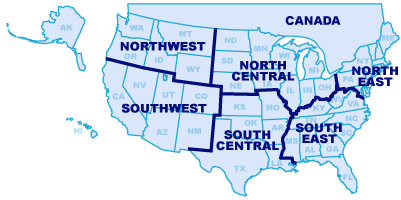
Click on the map below to bring schools in the selected region to the top of the list:







Articles on Communication / Mass Communication:
A Future with a Communication Degree
By Calli Wolfenden, Staff Writer
A major in communication focuses on the ways that we relate to one another, disseminate information, and interact. It’s about interaction and understanding. A communication degree teaches students how to deliver a message effectively, through different mediums like storytelling, speech, or digital media, in a way that is most effective for their audience. It’s about more than just crafting a message but knowing how best to do so for the right audience. A communication degree will show students the power of effective communication.
Getting a communication degree from a Christian college will allow students to better empathize with audiences that approach truth with skepticism. It will teach students strong communication skills through the perspective of interaction as a gift from God, with each person being made in the image of their creator. A major in communication at a Christian college emphasizes responsibility and integrity in how we communicate with others while harnessing students’ creative abilities to best glorify the God who gifted them.
Some example careers for students who major in communication:
- Public relations specialist: A Public Relations Specialist is in charge of maintaining or improving the company’s reputation. They work to create a positive public image through communicating achievements, good works, community engagement, or other good things with the press, social media, or other public outlets. They also handle crisis management for negative events or bad publicity, working to minimize the damage to the company/client’s image.
- Marketing Coordinator: Marketing coordinators oversee marketing initiatives, organize promotional activities, and manage social media and website presence. Their work often involves researching market trends and analyzing results and effects from previous or current marketing strategies implemented at the company.
- Social Media Manager: Social Media Managers, as the name implies, manage the social media accounts and presence of a company or client. They create content, analyze social media metrics and interaction with their content, come up with strategies to increase their brand awareness and public engagement. They may also work with other departments for marketing or advertising projects.
- Journalist/Reporter: A Journalist/Reporter’s main job is to inform the public about current events or trends as accurately as possible. They do this by conducting interviews, research, and investigations and compiling the accounts and presenting them as objectively as possible. They must adhere to ethical standards and verify their sources of information. Their work may be presented in a variety of mediums, such as newspapers, radio, or television, among others.
- Broadcast Producer: The Broadcast Producer is in charge of the content that goes into a type of broadcast, be it television, radio, or online programming. They work with writers, directors, content creators, talent, and crew throughout the production process, and have the final say in what is included and excluded from the final airing. In the long list of their responsibilities, scheduling, budgeting, and ensuring quality standards are among their primary roles.
- Human Resources Specialist: A Human Resources Manager oversees the employees in a workforce, ensuring that HR policies and labor laws are complied with. They also serve a function of peacekeeping, as one of their primary functions is conflict-resolution and fostering a positive work environment. Typically, they also handle onboarding, training, and hiring of new employees.
- Speechwriter: Speechwriters work closely with clients, often politicians, executives, or other kinds of leadership roles, to create narratives that closely align with the voice, goal, and values of the speaker while being persuasive and impactful. They often conduct considerable research into the topics of the speech and incorporate rhetorical techniques into the speech to effectively deliver the speaker’s message.
A communication degree offers knowledge and skill that is applicable to a myriad of career opportunities. Those with a communication degree may see a median annual salary of around $60,000 post-graduation, but there is a lot of variety in possible careers that could mean higher or lower salary. The ability to communicate effectively and competently to a targeted audience or the general public, opens doors in all sorts of businesses and career roles. As such, the placements rates for those who major in communication are generally quite high. That said, there are steps one needs to take in college to make the transition from class to career as seamless as possible.
Relevant experience is key in landing a job in any field right out of college. While pursuing your communication degree, be sure to take on internships, part-time jobs, or even volunteering in roles that give you experience in the career field that you desire. A major in communication opens a lot of doors, but nearly all of them look for candidates that have some experience in the workforce and in their field. Take on these roles to gain applicable experience that will combine with your communication degree to make you a valuable prospective employee.
Start building a network while you are studying and working these internships/jobs. Make connections with your coworkers, employers, and even professors, as they often have experience in the field outside of teaching. These connections can be key in landing a job, promotion, or even just an interview post-graduation. Having someone who can vouch for your experience and work ethic who knows the field is no small thing.
Communication is about connection as much as it’s about message. Having strong emotional intelligence is crucial for relating to an audience and effectively communicating. Strong interpersonal skills are also important as most careers coming from a communication degree require working as part of a team, be it in broadcasting, marketing, or even speech writing. Creativity and problem solving will set you apart in the field, where the most engaging medium will deliver your message best and hold the attention of the audience. Being a strong communicator, effective teammate, and creative mind will make you a great candidate for any number of roles with a communication degree, including ministry and service in the Church.
Works Cited:
- Bureau of Labor Statistics, U.S. Department of Labor, Occupational Outlook Handbook, Field of degree: Communications,at https://www.bls.gov/ooh/field-of-degree/communications/communications-field-of-degree.htm (visited October 15, 2024).
A Communication Degree and Ministry
By Calli Wolfenden, Staff Writer
Strong communication is especially important when the subject matter is the gospel. Knowing how best to relate to an audience, be it your congregation, local community, or global setting, is vital to spreading the truth and love of God.
Proverbs 16:23
“The hearts of the wise make their mouths prudent, and their lips promote instruction.”
Ephesians 4:29
“Do not let any unwholesome talk come out of your mouths, but only what is helpful for building others up according to their needs, that it may benefit those who listen.”
The Church has no shortage of need for good communicators. Someone with a communication degree can be a great asset in content creation, marketing, outreach, and more. Those who major in communication can bring their expertise to a Church’s communication, as a communications director, overseeing all forms of communication, from marketing to newsletters to messaging, and more. They can assist in creating content that informs and speaks to both the Church community and surrounding communities. Public relations is also in their wheelhouse, allowing them the opportunity to represent the Church community and find areas of improvement to better reach those around them.
Communication skills are also desired in ministry. Being able to communicate with different communities and effectively share the gospel in ways that diverse audiences can relate to and understand it is a huge benefit to mission work. Being able to work with different types of communication, from written word to presentations, speeches, and digital media to reach multiple audiences is also a huge plus in a ministry setting. From writing sermons to creating engaging content, to connecting with communities, both global and nearby, someone who knows how to deliver a message and relate to an audience will have no trouble finding a place in the Church or in ministry.
A communication degree opens the doors to all kinds of career opportunities, in business and ministry. If you are a strong communicator, empathetic, creative, and dedicated to crafting messages for best understanding then perhaps the Lord is calling you to major in communication!